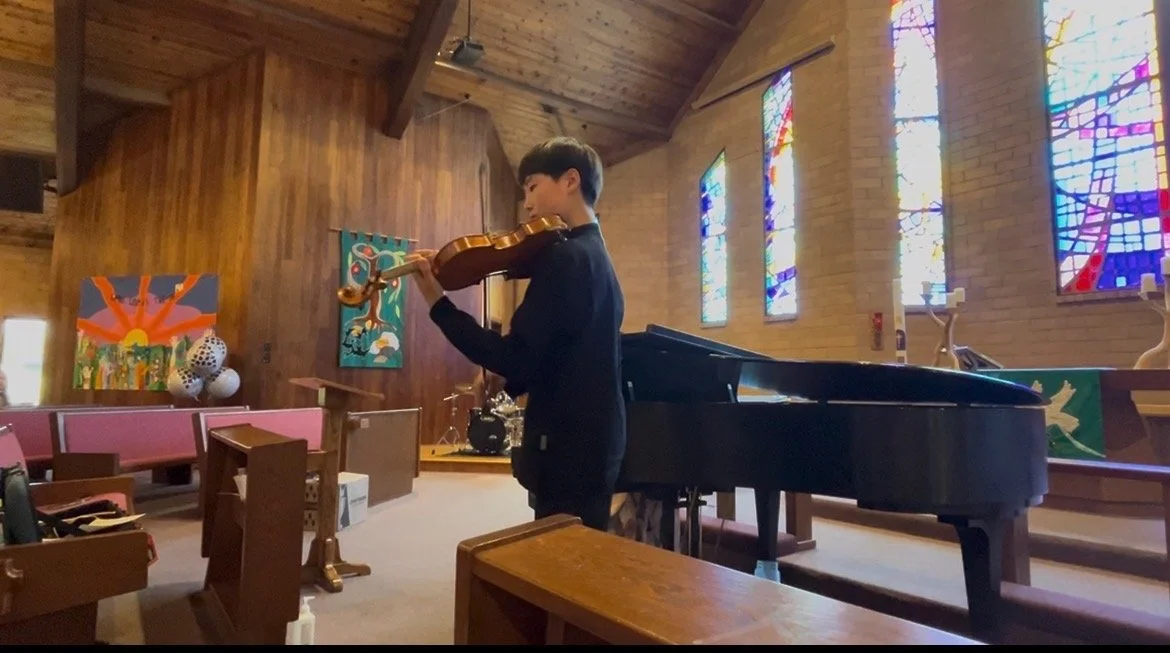
What was the moment that made you realize you loved your instrument? Was there a piece or performance that helped you feel connected to playing music?
The moment that made me realize that I loved my instrument was probably when I watched a video of an orchestra concert in Japan, playing pieces from Studio Ghibli films. I was really intrigued and inspired by the range of sounds that the orchestra made, and I noticed that I really liked how the string section sounded. At first, I was also considering playing cello, but the violin section seemed more interesting/played the melody parts more, which led me to choose to play the violin.
How would you describe your relationship with your instrument?
Recently, my instrument, or music in general, has connected me with a lot of people, and I’ve also been doing more competitions/events to practice for, which has made me connect and love playing the violin even more. When I started playing violin, though, I did have some days when I didn’t want to practice and hated my instrument, but I feel that those moments were impulsive, and I would usually want to practice the day after, even after a few hours.
How would you describe your teacher’s teaching style in three words?
Expressive, passionate, and onomatopoeic.
Can you describe a challenging moment during a lesson and explain how you and your teacher worked through it?
One moment that comes to mind is when I was still in elementary school and struggling with a fast passage in one of the Suzuki books. I was told to play the passage, which originally was straight sixteenth notes, in a dotted 16th-32nd rhythm, and the other way around. This was my first time doing this kind of exercise, but it revealed that I was struggling with one of the rhythm variations, so I practiced the passage in that rhythm, and I was able to play consistent straight sixteenth notes for that piece afterward.
Do you have any funny practice habits or precompetition rituals?
Before competitions or concerts, my hands usually get really cold, so I make sure to bring some hand warmers to warm them up for my performance. This used to happen more often when I was younger, so I used to bring 3 packs of hand warmers every performance.
For younger students just starting on their instruments, what’s one piece of practice advice you would give?
Staying consistent with practicing is key — even practicing just 30 minutes every day is better than practicing for an hour once in a while.
Could you describe your experience in preparing for your most recent competition or performance? What was that journey like?
My most recent performance was playing the 3rd movement of Baal Shem by Ernest Bloch at Carnegie Hall. I was on a school trip the week before, which meant I couldn’t practice for the week before the concert, so I tried to practice as much as I could before the week started. When I arrived in New York, I only had one day to practice and rehearse with my accompanist, so I practiced for around 3 hours in a practice room we rented out and had a 30-minute rehearsal with my accompanist. I think that since I was already well-prepared before the school trip, I didn’t feel the need to practice that much on the day of the concert. Also, only practicing for 3 hours and having a short rehearsal with my accompanist made me less stressed, which was a positive. I’m most proud of this performance, and it my first time playing at Carnegie Hall, which is an accomplishment, and the experience was really eye-opening.
How do you think music will shape your life moving forward? Do you plan on incorporating music in your busy college life?
Even though I don’t plan to play violin professionally or as a career, I do plan to minor in music performance, or at least take private lessons and participate in orchestra or chamber groups during college. I really think orchestra and chamber music are really good ways to make connections, so I plan to keep participating in community/college orchestras or chamber groups moving forward.
What lessons will you take from learning music?
Learning to play music made me realize and appreciate how much work goes into the music you hear every day. If it weren’t for playing violin, I think I would think of music just as another time passer/activity/background noise, but playing music made me appreciate and view music more as an art. Even though the music I listen to on the daily is mostly non-classical music, I still recognize musical devices in the tunes I hear every day, which makes me appreciate it more.
From Yuito’s mom:
Yuito has been taking lessons with Mr. Josh since he was very young, how did you decide to take lessons with Mr. Josh?
When Yuito wanted to switch from piano to violin at age six, I was looking for a violin teacher who could be a role model for him. I also hoped he could learn polite and thoughtful Japanese through his lessons.
With piano, Yuito sometimes seemed frustrated by the gap between what he could play and what he wanted to play. He was drawn to more challenging pieces, such as original compositions by Joe Hisaishi.
With the violin, the connection between his musical ideas and his body seemed much more direct. He literally played with the instrument and loved playing what he heard. I could see how much he enjoyed learning with Mr. Josh.
As Yuito has grown, I’ve especially appreciated Mr. Josh’s balance of flexibility and challenge he gave to Yuito. Thank you for supporting Yuito’s commitments to sports, along with setting the milestones for his violin competitions and audition recording.
And one more thing makes Mr. Josh especially popular in our family: he is also a professional chef and pâtissier! Yuito absolutely loves his baking. We recently talked about how Mr. Josh used to treat us to his delicious baking often when Yuito was younger, and we’re so happy that he has started making them again recently!
Were there any aspects of Mr. Josh’s teaching that were especially helpful for Yuito?
Now that Yuito has had opportunities to learn from different teachers through his orchestra and summer programs, he has come to appreciate Mr. Josh’s teaching even more. Yuito said that Mr. Josh is very precise about teaching specific techniques to create specific sounds to express emotions, for example, which bow or which string position to use, and exactly how to use them to create a certain sound. Yuito really appreciates understanding this connection between technique and musical expression.
As a parent who does not play the violin myself, I also appreciate how well Mr. Josh knows Yuito’s musical preferences and abilities. He consistently chooses pieces that Yuito enjoys while also making sure he learns the repertoire and techniques he needs as a violinist, including pieces required for auditions and competitions. I think this balance and flexibility have helped Yuito continue to enjoy playing while steadily developing as a musician.
From Mr. Josh, Yuito’s Teacher
I have been teaching Yuito since first grade. I rarely accept students that young, but his maturity quickly won me over. Even early on, he had his own musical vision, so I avoided imposing too many of my own ideas on him. Still, he remains open to my guidance once I explain why it matters. He has already exceeded my expectations, and I am thrilled to see where his music takes him next.